Pivoting with Purpose: How Developers Are Reframing Opportunity in the Lower Mainland

Across the Lower Mainland in British Columbia, developers are taking a closer look at how the market has changed and what it now takes to move a project forward. The assumptions that once drove presale‑driven development no longer hold the same certainty they once did. Instead, builders are in a period of reassessment, where flexibility and long‑term thinking are becoming just as important as speed to market.
For some, this shift has been gradual. For others, it has been happening through a combination of rising construction costs, softening sale prices, and a presale environment that has grown increasingly difficult to rely on. But for many builders, this moment is about more than just managing risk. It is about identifying where opportunity still exists.
That’s the lens through which Associate Director of Origination, Devon McAndrews views the shift.

“Presales just aren’t there in the way they used to be,” he shared, speaking from direct experience working with developers across the region. Projects that once depended on selling the majority of units before breaking ground are now facing a buyer pool that is far more hesitant to commit to future pricing.
For developers, reliance on presales has become increasingly challenging and why many are widening their focus toward more durable development models.
Where Policy Meets Possibility
As McAndrews noted, market conditions are only part of the story. Policy changes have also played a meaningful role in reshaping development decisions, particularly with the introduction of Bill 47 and the continued emphasis on transit‑oriented density across British Columbia.
Areas near SkyTrain stations, major bus exchanges, and regional rail have seen increased allowable density and clearer development frameworks. These changes have improved feasibility for rental projects by reducing rezoning risk and aligning planning objectives with long‑term housing demand.
“Removing rezoning risk is extremely important,” McAndrews shared. “It gives developers confidence. It gives projects momentum.”
Municipalities such as Vancouver, Burnaby, Surrey, and Coquitlam have made meaningful progress in supporting rental development through measures like density bonuses and expedited approvals. While these steps represent real improvement, there is still work to be done at both the municipal and provincial levels to deliver a smoother, more consistent entitlement process that allows projects to move forward with greater certainty.
Rewriting the Development Mindset
For many builders, pivoting from for‑sale to rental is not simply a financial adjustment. It’s a shift in mindset.
McAndrews acknowledges that developers often approach for‑sale projects with an eye toward design, finish, and immediate return, something that defined the market up until 2019. Rental, however, requires a different kind of thinking: operational durability, property management readiness, and long‑term revenue planning.
But this shift doesn’t have to be daunting.

Larger groups have demonstrated that patient capital can build portfolios that weather downturns, refinance on predictable timelines, and ultimately create generational stability.
“That build‑hold‑refinance model works,” he said. “And it’s repeatable.”
That model is increasingly resonating with smaller and mid‑sized developers as well, particularly in a market where presale absorption has become less predictable. Rental income, while not immune to market shifts, has historically shown greater stability during economic downturns.
Why Financing Structure Is Driving the Shift
Beyond market sentiment and policy support, the financing structure has become one of the clearest differentiators between for‑sale and rental development today.
For conventional condo projects, access to construction financing is still largely tied to presales. In most cases, developers are expected to secure commitments on 60 to 70 percent of units before lenders are willing to advance capital. Even with reasonable leverage — typically in the 70 to 75 percent range — those presales remain the foundation of underwriting.
Rental projects operate very differently.
Rather than relying on future sales, CMHC‑insured rental programs are underwritten based on stabilized net operating income. That distinction has meaningful implications for both equity requirements and risk exposure. In practice, it allows projects to move forward without presales, provided the fundamentals support long‑term performance.
In a conventional presale‑driven condo project, developers may be required to contribute 25 percent or more of total project costs, with a significant portion of that equity deployed well before construction financing is advanced. By contrast, MLI‑insured rental projects typically support higher loan‑to‑cost ratios, which reduces the amount of equity required upfront and, in some cases, allows a portion of that equity to be returned at construction funding.
The comparison below illustrates how these structures differ in practice.
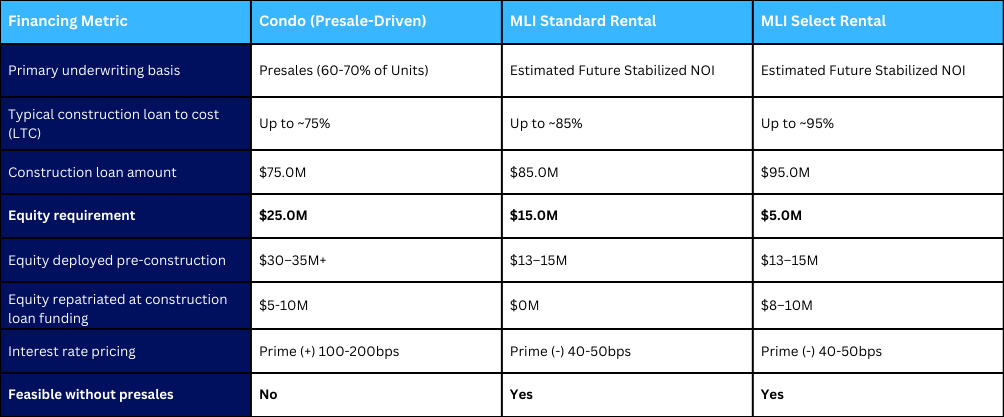
*Illustrative comparison based on $100M cost and typical market assumptions.
What the table makes clear is not just that rental projects require less equity, but that they fundamentally change when and how capital is deployed. For developers navigating a capital‑constrained environment, that shift can be the difference between a project moving forward or remaining stalled.
It also reinforces a broader theme emerging across the Lower Mainland. In a market where presales are increasingly difficult to secure, development models that are not dependent on future sales are gaining momentum. Rental financing, particularly through CMHC’s MLI programs, offers a level of predictability that many developers are actively seeking.
As McAndrews noted, that predictability matters. Not because it eliminates risk, but because it allows developers to manage it more effectively.
Long‑Term Thinking in a Short‑Term Market
Will presales return? Possibly. But not imminently.
Buyer hesitation, economic uncertainty, and the availability of move‑in‑ready alternatives all suggest a slower road back. McAndrews anticipates that it could take two to three years before presale‑driven projects to regain their former traction.
In the meantime, rental isn’t so much a fallback strategy as a forward‑looking one. Developers who lean into this moment with adaptability and clarity may find themselves better positioned not just to build, but to thrive.
“Rental creates certainty,” McAndrews shared. “And right now, certainty matters.”
Article Authored by

Associate Director, Mortgage Origination

Senior Mortgage Underwriter
Keeping With Good Company
Success in business comes in part by having the right advisors. Partner and Business Practice Leader...
Canada ICI Celebrates Global Corporate Real Estate & Facilities Management Award
Last month, Canada ICI received The Corporate Real Estate & Facilities Management Award from the Roy...
Related Articles